 |
|
 |
|







| ||||
|
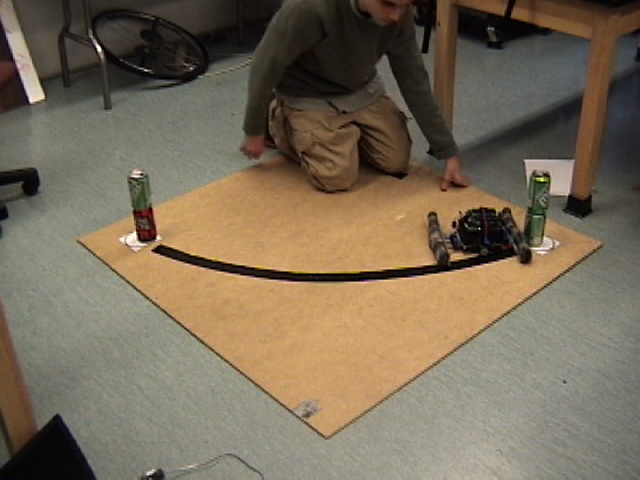
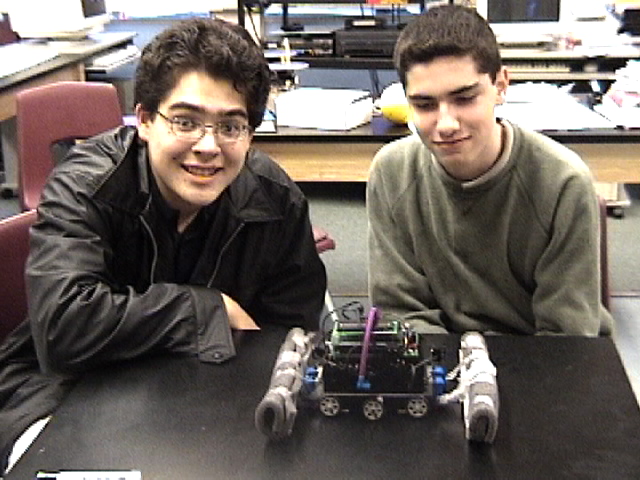
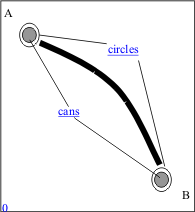
Following the rules below, try to beat the best time of the Harker School Robotics Club. They used a handyboard and lego components. Programming was done with IC (Interactive C). Times: Harker Robotics Club "Four Can Competition" contributors: Alan Malek, Alex Segal (chief programmer), Jerry Chi, Misha Nasdledov, Joel Wright, Aaron Kleinsteiber, Adrik McIlroy, Gregory Perkins and faculty advisor Dr. Randal Harrington (physics teacher). The Challenge: Construct and program a small autonomous mobile robot using the pieces from a Botball competition kit, a FIRST LEGO League kit or LEGO Mindstorms kit. The robot must move between two stacks of soda cans without knocking the cans over or moving them outside the circles. The objective is to move from one stack of cans to the other and back in the shortest amount of time. The challenge board may be constructed from a standard piece of white tile board (available at home improvement or hardware stores-the same as is used in the Botball tournaments), black cloth tape (about 2 inches wide) and four aluminum soda cans (two empty and two full) using the diagram below.
The Rules: 1. The robot cannot use more than two drive motors. 2. Each robot should wait five seconds after the start button has been pressed before moving. The time of the run will start when the robot starts to move. 3. The robot starts with one end of the robot within the 4" circle that surrounds the "A" can tower. 4. Robots must start moving within 10 seconds after the run button has been pushed. If they do not, they will receive a maximum time for the run (30 seconds). 5. Robots must finish the course within 30 seconds. If they do not, they will be assigned that time. 6. Robots can take any path they wish, but… 7. Robots must move from overlapping the "A" tower circle to overlapping the circle that surrounds the "B" tower, and then back to the "A" tower circle. Robots may touch the can, but will be penalized if they move any can outside of its corresponding circle. 8. Robot wheels must not leave the challenge board (or if the board is edged, the robot cannot touch the edge). 9. Robots must stop when the task is completed. 10. Robots must not be more
than 12 inches in any dimension at any time of their run. Scoring: 1. The winning robot will be
chosen based upon its performance. 2. The robot performance is evaluated based on time:
Awards and Recognition:
|
|||||
|
|
|||||
 This web site subscribes
to the COPPA (Children's Online Privacy Protection Act) policy established
at NASA Headquarters.
We
may link to other sites for the convenience of visitors to this site. We
cannot be responsible for the content or collection practices of these sites
and recommend you read their privacy policies before providing them information.
This web site subscribes
to the COPPA (Children's Online Privacy Protection Act) policy established
at NASA Headquarters.
We
may link to other sites for the convenience of visitors to this site. We
cannot be responsible for the content or collection practices of these sites
and recommend you read their privacy policies before providing them information.
Last updated 02/14/02 |
 NASA-recognized races must be supported by a supervising teacher.